
This website uses cookies to give you the best user experience. If you continue
without changing your settings we'll assume you are happy to receive all RSC cookies.
You can change your cookie settings by navigating to our Privacy and Cookies page and following the instructions. These instructions
are also obtainable from the privacy link at the bottom of any RSC page.
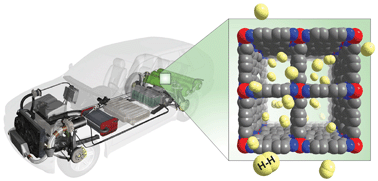
New materials capable of storing hydrogen at high gravimetric and volumetric densities are required if hydrogen is to be widely employed as a clean alternative to hydrocarbon fuels in cars and other mobile applications. With exceptionally high surface areas and chemically-tunable structures, microporous metal–organic frameworks have recently emerged as some of the most promising candidate materials. In this critical review we provide an overview of the current status of hydrogenstorage within such compounds. Particular emphasis is given to the relationships between structural features and the enthalpy of hydrogen adsorption, spectroscopic methods for probing framework–H2 interactions, and strategies for improving storage capacity (188 references).
Fetching data from CrossRef. This may take some time to load.