


 SCHEDULED MAINTENANCE

A hybrid chip based on aerodynamics and electrostatics for the size-dependent classification of ultrafine and nano particles
Abstract
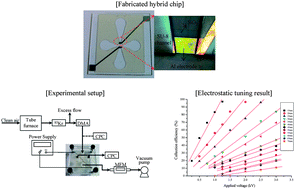
Conventional virtual impactors experience a large pressure drop when they classify particles according to size, in particular ultrafine particles smaller than 100 nm in diameter. Therefore, most virtual impactors have been used to classify particles larger than 100 nm. Their cut-off diameters are also fixed by the geometry of their flow channels. In the proposed virtual impactor, particles smaller than 100 nm are accelerated by applying DC potentials to an integrated electrode pair. By the electrical acceleration, the large pressure drop could be significantly decreased and new cut-off diameters smaller than 100 nm could be successfully added. The geometric cut-off diameter (GCD) of the proposed virtual impactor was designed to be 1.0 µm. Performances including the GCD and wall loss were examined by classifying
 Please wait while we load your content...


