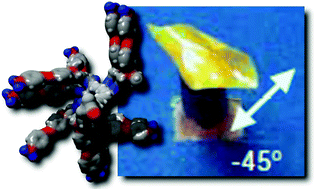
The change in shape inducible in some photo-reversible molecules using light can effect powerful changes to a variety of properties of a host material. The most ubiquitous natural molecule for reversible shape change is the rhodopsin–retinal protein system that enables vision, and this is perhaps the quintessential reversible photo-switch. Perhaps the best artificial mimic of this strong photo-switching effect however, for reversibility, speed, and simplicity of incorporation, is azobenzene. This review focuses on the study and application of reversible changes in shape that can be achieved with various systems incorporating azobenzene. This photo-mechanical effect can be defined as the reversible change in shape inducible in some molecules by the adsorption of light, which results in a significant macroscopic mechanical deformation of the host material. Thus, it does not include simple thermal expansion effects, nor does it include reversible but non-mechanical photo-switching or photo-chemistry, nor any of the wide range of optical and electro-optical switching effects for which good reviews exist elsewhere.
You have access to this article
 Please wait while we load your content...
Something went wrong. Try again?
Please wait while we load your content...
Something went wrong. Try again?


 SCHEDULED MAINTENANCE