This website uses cookies to give you the best user experience. If you continue
without changing your settings we'll assume you are happy to receive all RSC cookies.
You can change your cookie settings by navigating to our Privacy and Cookies page and following the instructions. These instructions
are also obtainable from the privacy link at the bottom of any RSC page.
Department of Chemistry and Biochemistry, Center for Nano- and Molecular Science and Technology, Texas Materials Institute, The University of Texas at Austin, Austin
Analyst, 2006,131, 262-267
DOI:
10.1039/B506869J
Received
16 May 2005,
Accepted
17 Jun 2005
First published online
30 Sep 2005
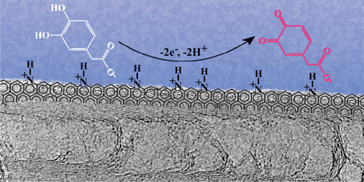
The differences in the electrochemical oxidation of two commonly known catecholamines, dopamine and norepinephrine, and one catechol, dihydroxyphenylacetic acid (DOPAC), at three different types of carbon based electrodes comprising conventionally polished glassy carbon (GC), nitrogen-doped carbon nanotubes (N-CNTs), and non-doped CNTs were assessed. Raman microscopy and X-ray photoelectron spectroscopy (XPS) were employed to evaluate structural and compositional properties. Raman measurements indicate that N-CNT electrodes have ca. 2.4 times more edge plane sites over non-doped CNTs. XPS data show no evidence of oxygen functionalities at the surface of either CNT type. N-CNTs possess 4.0 at. % nitrogen as pyridinic, pyrrolic, and quaternary nitrogen functionalities that result in positively charged carbon surfaces in neutral and acidic solutions. The electrochemical behavior of the various carbon electrodes were investigated by cyclic voltammetry conducted in pH 5.8 acetate buffer. Semiintegral analysis of the voltammograms reveals a significant adsorptive character of dopamine and norepinephrine oxidation at N-CNT electrodes. Larger peak splittings, ΔEp, for the cyclic voltammograms of both catecholamines and a smaller ΔEp for the cyclic voltammogram for DOPAC at N-CNT electrodes suggest that electrostatic interactions hinder oxidation of cationic dopamine and norepinephrine, but facilitate anionic DOPAC oxidation. These observations were supported by titrimetry of solid suspensions to determine the pH of point of zero charge (pHpzc) and estimate the number of basic sites for both CNT varieties. This study demonstrates that carbon purity, the presence of exposed edge plane sites, surface charge, and basicity of CNTs are important factors for influencing adsorption and enhancing the electrochemical oxidation of catecholamines and catechols.
Fetching data from CrossRef. This may take some time to load.