


 PLATFORM UPDATE:

UV-induced DNA damage and repair: a review
Abstract
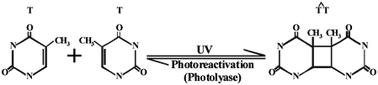
Increases in ultraviolet radiation at the Earth's surface due to the depletion of the stratospheric ozone layer have recently fuelled interest in the mechanisms of various effects it might have on organisms. DNA is certainly one of the key targets for UV-induced damage in a variety of organisms ranging from bacteria to humans. UV radiation induces two of the most abundant mutagenic and cytotoxic DNA lesions such as cyclobutane–pyrimidine dimers (CPDs) and 6–4 photoproducts (6–4PPs) and their Dewar valence isomers. However, cells have developed a number of repair or tolerance mechanisms to counteract the DNA damage caused by UV or any other stressors. Photoreactivation with the help of the enzyme photolyase is one of the most important and frequently occurring repair mechanisms in a variety of organisms. Excision repair, which can be distinguished into base excision repair (BER) and nucleotide excision repair (NER), also plays an important role in DNA repair in several organisms with the help of a number of glycosylases and polymerases, respectively. In addition, mechanisms such as mutagenic repair or dimer bypass, recombinational repair, cell-cycle checkpoints, apoptosis and certain alternative repair pathways are also operative in various organisms. This review deals with UV-induced DNA damage and the associated repair mechanisms as well as methods of detecting DNA damage and its future perspectives.
 Please wait while we load your content...
