


Preparation and performance evaluation of rare earth metal Eu(iii)-mediated docosahexaenoic acid-imprinted microspheres

Abstract
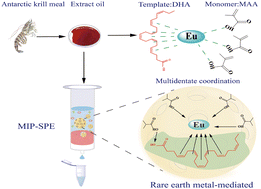
Docosahexaenoic acid (DHA), widely found in marine organisms, is subject to continuously growing demand in the fields of pharmaceuticals, infant nutrition, and biomaterials. However, due to the low content of DHA in biological samples and the complexity of the matrices, a complicated extraction process is required to obtain a high-purity product. In this experiment, an imprinted polymer microsphere with specific selectivity for DHA was successfully synthesized using a rare earth metal ion-mediated strategy with europium(III) acetate hydrate (Eu(CH3COO)3·4H2O) as the mediator, DHA as the template molecule, and methacrylic acid (MAA) as the functional monomer. The imprinted polymer microsphere was used for the enrichment and purification of DHA from Antarctic krill meal (AKM). Through systematic optimization of key synthesis parameters, including mediating ion species and concentration, functional monomer content, etc., the adsorption capacity of the developed molecular-imprinted polymers (MIPs) has been enhanced to 0.054 g g−1, with an imprinting factor reaching 4.203. Physical characterization methods, such as scanning electron microscopy, Fourier transform infrared spectroscopy, and X-ray photoelectron spectroscopy, were used to confirm the successful preparation of the porous imprinted microspheres. The solid phase extraction of AKM under the optimal adsorption conditions yielded DHA with 62.18% purity, while the total purity of DHA + EPA could reach 95.98%, which was a 2.4-fold increase in purity, and the recoveries of MIPs ranged from 86.58% to 93.35% (RSD = 3.19%). The linear range of the method was 58.77–100 000 μg mL−1, the limit of detection was 19.40 μg mL−1, and the limit of quantification was 58.77 μg mL−1. In summary, the imprinted microspheres prepared in this experiment demonstrate the selective enrichment and purification of DHA from AKM, offering a novel extraction method for isolating DHA.
 Please wait while we load your content...


