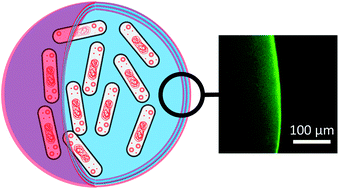
The oral administration of probiotic bacteria has shown potential in clinical trials for the alleviation of specific disorders of the gastrointestinal tract. However, cells must be alive in order to exert these benefits. The low pH of the stomach can greatly reduce the number of viable microorganisms that reach the intestine, thereby reducing the efficacy of the administration. Herein, a model probiotic, Bifidobacterium breve, has been encapsulated into an alginate matrix before coating in multilayers of alternating alginate and chitosan. The intention of this formulation was to improve the survival of B. breve during exposure to low pH and to target the delivery of the cells to the intestine. The material properties were first characterized before in vitro testing. Biacore™ experiments allowed for the polymer interactions to be confirmed; additionally, the stability of these multilayers to buffers simulating the pH of the gastrointestinal tract was demonstrated. Texture analysis was used to monitor changes in the gel strength during preparation, showing a weakening of the matrices during coating as a result of calcium ion sequestration. The build-up of multilayers was confirmed by confocal laser-scanning microscopy, which also showed the increase in the thickness of coat over time. During exposure to in vitro gastric conditions, an increase in viability from <3 log(CFU) per mL, seen in free cells, up to a maximum of 8.84 ± 0.17 log(CFU) per mL was noted in a 3-layer coated matrix. Multilayer-coated alginate matrices also showed a targeting of delivery to the intestine, with a gradual release of their loads over 240 min.
You have access to this article
 Please wait while we load your content...
Something went wrong. Try again?
Please wait while we load your content...
Something went wrong. Try again?


