This website uses cookies to give you the best user experience. If you continue
without changing your settings we'll assume you are happy to receive all RSC cookies.
You can change your cookie settings by navigating to our Privacy and Cookies page and following the instructions. These instructions
are also obtainable from the privacy link at the bottom of any RSC page.
Department of Chemistry and the Materials Science Institute, University of Oregon, Eugene, USA
E-mail: dwj@uoregon.edu
; Fax: +1 541 346 0487
; Tel: +1 541 346 1695
Chem. Sci., 2013,4, 585-590
DOI:
10.1039/C2SC21501B
Received
12 Sep 2012,
Accepted
29 Oct 2012
First published online
30 Oct 2012
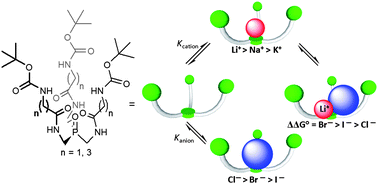
Previous work on a ditopic receptor based on a tripodal phosphine oxide core demonstrated preferential enhancement of bromide binding over chloride or iodide in the presence of lithium cation. Current studies on an elongated receptor provide evidence that preferential bromide binding enhancement in the presence of lithium cation is common to this receptor class in general, and that lengthening of the receptor results in an overall increase in halide association. Furthermore, the extended receptor shows a strong preference for Li+ binding in solution.
Fetching data from CrossRef. This may take some time to load.