This website uses cookies to give you the best user experience. If you continue
without changing your settings we'll assume you are happy to receive all RSC cookies.
You can change your cookie settings by navigating to our Privacy and Cookies page and following the instructions. These instructions
are also obtainable from the privacy link at the bottom of any RSC page.
Department of Chemistry, University of Oxford, Chemistry Research Laboratory, Mansfield Road, Oxford, UK
E-mail: michael.willis@chem.ox.ac.uk
; Fax: +44 (0)1865 285002
; Tel: +44 (0)1865 285126
Chem. Soc. Rev., 2013,42, 63-76
DOI:
10.1039/C2CS35316D
Received
06 Aug 2012,
First published online
19 Oct 2012
The merged inverse-electron-demand hetero-Diels–Alder (ihDA)/retro-Diels–Alder (rDA) reaction sequence can be used to rapidly synthesise highly functionalised nitrogen heteroaromatics. The reaction offers many advantages: high atom economy, high levels of regioselectivity, it rarely requires a catalyst and, in some cases, can be performed in the absence of solvent. In this tutorial review we discuss the range of commonly used dienophiles and aza-dienes for this process whilst highlighting the reactivity trends, and illustrating their applications.
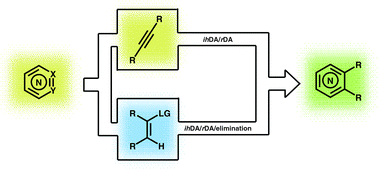
A review, with 85 references, highlighting the key features and applications of merged inverse-electron-demand hetero-/retro-Diels–Alder cascade processes, particularly as applied to the synthesis of aromatic nitrogen heterocycles.
Fetching data from CrossRef. This may take some time to load.