This website uses cookies to give you the best user experience. If you continue
without changing your settings we'll assume you are happy to receive all RSC cookies.
You can change your cookie settings by navigating to our Privacy and Cookies page and following the instructions. These instructions
are also obtainable from the privacy link at the bottom of any RSC page.
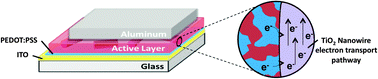
Charge transport is one of the five main steps in the operation of organic photovoltaics, but achieving balanced hole and electron transport with high mobility has been challenging in devices. Here, we report improved charge transport in organic photovoltaics via incorporation of nanostructured inorganic electron transport materials into the active layers of devices. Co-depositing TiO2 nanowires with the organic active layer solution embeds the nanowires directly within active layers of the solar cell. The ability of these nanowires to transport electrons is compared with neat P3HT:PCBM active layers and also devices containing TiO2 nanotube aggregates. Incorporation of TiO2 nanowires yields a six-fold increase in the electron mobility relative to unmodified devices, leading to a 19% improvement in the power conversion efficiency. Lower energetic disorder of the film and more balanced charge transport are also observed upon incorporating TiO2 nanowires. These advantageous effects correlate with the TiO2 nanowire length.
Fetching data from CrossRef. This may take some time to load.
Physical Chemistry Chemical Physics
- Information Point