This website uses cookies to give you the best user experience. If you continue
without changing your settings we'll assume you are happy to receive all RSC cookies.
You can change your cookie settings by navigating to our Privacy and Cookies page and following the instructions. These instructions
are also obtainable from the privacy link at the bottom of any RSC page.
Sub-ppm quantification of Hg(II) in aqueous media using both the naked eye and digital information from pictures of a colorimetric sensory polymer membrane taken with the digital camera of a conventional mobile phone
Departamento de Química, Facultad de Ciencias, Universidad de Burgos, Plaza de Misael Banuelos s/n, E-09001 Burgos, Spain
E-mail: jmiguel@ubu.es
; Fax: +34 947258831
; Tel: +34 947258085
Anal. Methods, 2013,5, 54-58
DOI:
10.1039/C2AY26307F
Received
17 Sep 2012,
Accepted
14 Nov 2012
First published online
15 Nov 2012
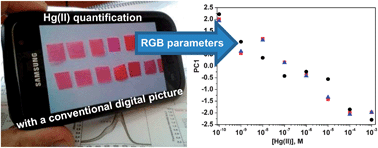
We present colorimetric sensory membranes for detecting Hg(II) in aqueous media. The colour response of the sensory materials can be tuned for detection with the naked eye, such as the maximum contaminant level of Hg(II) that is set by the United States Environmental Protection Agency (EPA) for drinking water. Furthermore, the concentration of Hg(II) can be monitored using digital pictures of the membranes taken with conventional cameras. Thus, nanomolar concentration of Hg(II) could be detected by the naked eye due to colour changes of membranes, and the concentration of Hg(II) could be quantified, within the millimolar to nanomolar range, by means of analysing the digital information of pictures taken of the membranes after dipping them in water containing this environmentally poisonous cation.
Fetching data from CrossRef. This may take some time to load.