


 SCHEDULED MAINTENANCE


Self-assembly scenarios of patchy colloidal particles†
Abstract
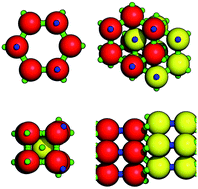
The rapid progress in precisely designing the surface decoration of patchy colloidal particles offers a new, yet unexperienced freedom to create building entities for larger, more complex structures in soft matter systems. However, it is extremely difficult to predict the large variety of ordered equilibrium structures that these particles are able to undergo, under the variation of external parameters such as temperature or pressure. Here we show that, by a novel combination of two theoretical tools, it is indeed possible to predict the self-assembly scenario of patchy colloidal particles: on one hand, a reliable and efficient optimization tool based on the ideas of evolutionary algorithms helps to identify the ordered equilibrium structures to be expected at T = 0; on the other hand, suitable simulation techniques allow us to estimate via free energy calculations the phase diagram at finite temperature. With these powerful approaches we are able to identify the broad variety of emerging
 Please wait while we load your content...


