


 SCHEDULED MAINTENANCE

Configuration of nonspherical amphiphilic particles at a fluid–fluid interface†
Abstract
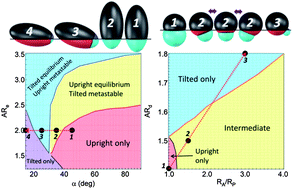
We present the equilibrium configuration of amphiphilic ellipsoids and amphiphilic dumbbells with asymmetric shape (i.e., unequal surface areas for apolar and polar sides) and surface wetting properties at an oil–water interface. The equilibrium configurations are obtained by minimizing the attachment energy of each amphiphilic particle as a function of orientation angle and vertical displacement of the particle with respect to the interface. We find that the orientation and vertical displacement of nonspherical amphiphilic particles are significantly influenced by their shape, aspect ratio, surface properties, and the location of the wettability separation line. In particular, due to the asymmetry in the particle geometry and wettability of these amphiphilic particles, we observe unique configurations that are not expected in symmetric Janus ellipsoids and dumbbells at fluid–fluid interfaces. In the case of amphiphilic ellipsoids, their orientation as a function of particle geometry and wettability can be divided into three regimes: upright orientation, tilted orientation, and coexistence of upright and tilted orientations due to the presence of secondary energy minima under appropriate conditions. In general, the secondary energy minimum is present when the aspect ratio of the ellipsoids becomes high. As for amphiphilic dumbbells, in addition to upright and tilted orientations, they can adopt intermediate orientations, especially when the size of the two spheres is significantly different, which leads to the detachment of one of the two spheres from the oil–water interface. This study provides guidelines for designing nonspherical amphiphilic particles with suitable geometry and wettability to tailor their properties as solid
 Please wait while we load your content...


