



Static wetting on deformable substrates, from liquids to soft solids
Abstract
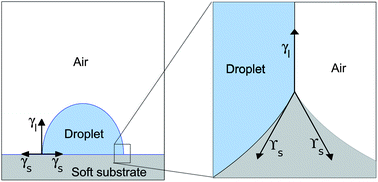
Young's law fails on soft solid and liquid substrates where there are substantial deformations near the contact line. On liquid substrates, this is captured by Neumann's classic analysis, which provides a geometrical construction for minimising the interfacial free energy. On soft solids, the total free energy includes an additional contribution from elasticity. A linear-elastic model incorporating an out-of-plane restoring force due to solid surface tension was recently shown to accurately predict the equilibrium shape of a thin elastic film due to a large sessile droplet. Here, we extend this model to find substrate deformations due to droplets of arbitrary size. While the macroscopic contact angle matches Young's law for large droplets, it matches Neumann's prediction for small droplets. The cross-over droplet size is roughly given by the ratio of the solid's surface tension and elastic modulus. On thin substrates at this cross-over, the macroscopic contact angle increases, indicating that the substrate is effectively less wetting. For droplets of all sizes, the microscopic behaviour near the contact line follows the Neumann construction giving local force balance.
- This article is part of the themed collection: Soft Matter Lectureship Winners
 Please wait while we load your content...


