This website uses cookies to give you the best user experience. If you continue
without changing your settings we'll assume you are happy to receive all RSC cookies.
You can change your cookie settings by navigating to our Privacy and Cookies page and following the instructions. These instructions
are also obtainable from the privacy link at the bottom of any RSC page.
Temperature-induced phase separation and hydration in poly(N-vinylcaprolactam) aqueous solutions: a study by NMR and IR spectroscopy, SAXS, and quantum-chemical calculations
Institute of Macromolecular Chemistry, Academy of Sciences of the Czech Republic, Heyrovsky Sq. 2, 162 06 Prague 6, Czech Republic
E-mail: spevacek@imc.cas.cz
; Fax: +420 296809410
; Tel: +420 296809380
Soft Matter, 2012,8, 6110-6119
DOI:
10.1039/C2SM25432H
Received
24 Feb 2012,
Accepted
30 Mar 2012
First published online
01 May 2012
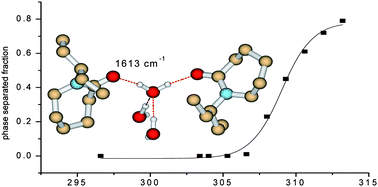
Temperature-induced phase separation and hydration in poly(N-vinylcaprolactam) (PVCL)–D2O solutions were investigated by a combination of NMR and ATR FTIR spectroscopy, SAXS and model quantum-chemical calculations. The existence and character of water bound in PVCL globular-like structures were shown by NMR spin–spin relaxation times of HDO molecules and by FTIR spectroscopy. From FTIR spectra combined with DFT calculations it follows that the amount of fully dehydrated carbonyl groups in PVCL globular structures is rather small. Dehydration at temperatures above the LCST transition mainly consists of transformation of structures where a PVCL carbonyl is directly hydrogen bonded to two water molecules to structures with a single hydrogen bonded water molecule and breaking away indirectly bound water. In the transition region the changes of hydrophilic and hydrophobic interactions proceed simultaneously. The strong dependence of transition temperatures on polymer concentration was revealed by NMR and SAXS. NMR spectroscopy also enabled us to determine thermodynamic parameters ΔH and ΔS characterizing the phase transition. SAXS results have shown that above the transition temperature “primary” mesoglobules of 50 nm in size are formed which aggregate into large agglomerates.
Fetching data from CrossRef. This may take some time to load.