This website uses cookies to give you the best user experience. If you continue
without changing your settings we'll assume you are happy to receive all RSC cookies.
You can change your cookie settings by navigating to our Privacy and Cookies page and following the instructions. These instructions
are also obtainable from the privacy link at the bottom of any RSC page.
Department of Chemical and Biomolecular Engineering and Center for Molecular and Engineering Thermodynamics, University of Delaware, 150 Academy Street, Newark, U.S.A
E-mail: furst@udel.edu
; Fax: +1 302 831 1048
; Tel: +1 302 831 0102
Soft Matter, 2012,8, 6198-6205
DOI:
10.1039/C2SM25187F
Received
24 Jan 2012,
Accepted
22 Mar 2012
First published online
16 Apr 2012
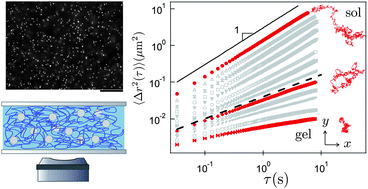
Microrheology uses the motion of dispersed colloidal probe particles to measure the viscosity or viscoelastic moduli of soft materials. The distinct advantages of microrheology include small sample volume requirements, access to a large range of time scales for the dynamic response and short acquisition times. These advantages make microrheology important for studies of biomaterial hydrogelators. Recent advances have enabled the precise characterization of hydrogelator sol–gel transitions, measurements of rare and scarce materials and high-throughput screening of hydrogel rheology over a large composition space. In this review, we focus on multiple particle tracking microrheology, including the considerations that define its operating regimes and its recent applications. Those interested in biomaterial rheology will find these methods as accessible as bulk rheological measurements and straightforward to implement in their own work.
Fetching data from CrossRef. This may take some time to load.