


 SCHEDULED MAINTENANCE

Motion induced by asymmetric enzymatic degradation of hydrogels†
Abstract
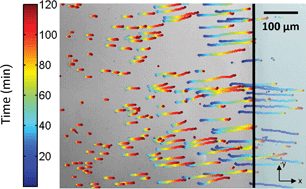
Biological hydrogels are continuously turned over through secretion and degradation. This non-equilibrium flux may be important for cellular and molecular transport through mucus and the extracellular matrix. Gel-digesting enzymes can drastically change the physical and chemical properties of the hydrogel environment. We report that a spatial gradient in the degradation of two gel/enzyme systems—gelatin/trypsin and hyaluronan/hyaluronidase—leads to directional motion of particles embedded in the gel in the direction of higher enzyme concentration. We study the rate at which the degradation front propagates through the gel and the ensuing velocity of the embedded particles, as functions of enzyme and gel concentrations. We propose that asymmetric degradation leads to asymmetric swelling, which transports particles up the enzyme concentration gradient.
 Please wait while we load your content...


