This website uses cookies to give you the best user experience. If you continue
without changing your settings we'll assume you are happy to receive all RSC cookies.
You can change your cookie settings by navigating to our Privacy and Cookies page and following the instructions. These instructions
are also obtainable from the privacy link at the bottom of any RSC page.
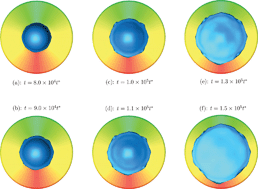
An active multiscale three-dimensional (3D) soft matter cell model is developed to study the mechanotransduction of stem cells in an attempt to explain mechanical information exchange between the cells and their extracellular environment. In the proposed soft matter cell model, the cortical actin–myosin flow or the cytoplasmic flow is modeled as an active nematic fluid gel, the cell nucleus is modeled as a hyperelastic medium, and the ligand–receptor interaction between the cell and extracellular matrix is modeled by a coarse-grained molecular adhesive potential. We have implemented the soft matter cell model in a Lagrange type meshfree Galerkin formulation, and we have developed computational algorithms for adhesive contact between the cell and substrate. A comparison study with experimental data has been conducted to validate the parameters of the cell model. By using the soft matter cell model, we have simulated soft adhesive contact/spreading process between the cell and the extracellular substrate. The numerical simulation shows that the cell can sense substrate elasticity in a variety of different ways from cell spreading motion to cell shape and configuration changes.
Fetching data from CrossRef. This may take some time to load.