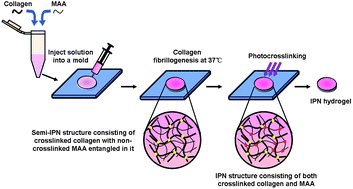
Hydrogels hold great promise for bone tissue engineering but their application is greatly limited by their low cell affinity and poor mechanical properties, as well as limited cell spreading ability for anchorage dependent cells such as osteoblasts. In this study, a series of hydrogels based on an interpenetrating polymer network (IPN) of methacrylated alginate (MAA) and collagen were developed to support pre-osteoblast spreading and proliferation as well as osteogenic differentiation. Compared to the pure MAA hydrogel, these hydrogels demonstrated higher mechanical moduli, lower swelling ratios and denser network structures. Moreover, the properties could be fine-tuned by altering the ratio of collagen and alginate. MC3T3-E1 cells in IPN hydrogels exhibited a rapid proliferation and spread gradually with prolonged culture time, and their osteogenic differentiation was greatly facilitated. While for the MAA hydrogel, the cells remained in a rounded morphology with bad osteogenic differentiation. These results should provide collagen–MAA IPN hydrogels as potential three-dimensional scaffolds for bone tissue engineering.
You have access to this article
 Please wait while we load your content...
Something went wrong. Try again?
Please wait while we load your content...
Something went wrong. Try again?


 SCHEDULED MAINTENANCE