



Design of patchy particles using ternary self-assembled monolayers
Abstract
Recent simulations have studied the formation of patterns in a binary mixture of immiscible
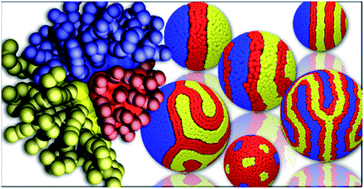
Recent simulations have studied the formation of patterns in a binary mixture of immiscible

I. C. Pons-Siepermann and S. C. Glotzer, Soft Matter, 2012, 8, 6226 DOI: 10.1039/C2SM00014H
To request permission to reproduce material from this article, please go to the Copyright Clearance Center request page.
If you are an author contributing to an RSC publication, you do not need to request permission provided correct acknowledgement is given.
If you are the author of this article, you do not need to request permission to reproduce figures and diagrams provided correct acknowledgement is given. If you want to reproduce the whole article in a third-party publication (excluding your thesis/dissertation for which permission is not required) please go to the Copyright Clearance Center request page.
Read more about how to correctly acknowledge RSC content.
 Please wait while we load your content...

