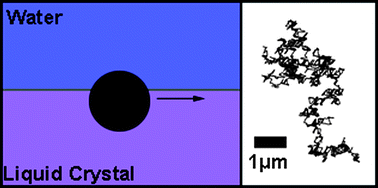
We report the use of single-particle tracking to measure the diffusion coefficients of chemically functionalized micro- and nano-particles at interfaces between aqueous phases and a nematic liquid crystal (LC). For hydrophobic particles with diameters of 2.3 ± 0.2 μm that homeotropically anchor the LC, we measured anisotropic diffusion, qualitatively consistent with the influence of nematic ordering of the LC at the interface on the local rheological environment. Analysis of the magnitudes of the diffusion coefficients reveals that the ordering of the LC about the microparticles is perturbed in the interfacial environment relative to the bulk, leading to low drag on the microparticles at the aqueous–nematic interface. In contrast, for hydrophobic nanoparticles (diameters of 141 ± 11 nm) at the LC–aqueous interface, almost indistinguishable diffusion coefficients were measured at the interface and in bulk LC when the displacements of the nanoparticles in the two environments were in the same directions relative to the far-field director of the LC. These results and others reported in this paper reveal fundamental differences that exist between the interfacial mobilities of micro- and nanoparticles at LC–aqueous interfaces, and that a relative insensitivity to interfacial environment appears to be a property of the smaller particles studied in our experiments. These findings are discussed in light of past studies of the diffusion of particles at either isotropic liquid interfaces or in bulk LCs.
You have access to this article
 Please wait while we load your content...
Something went wrong. Try again?
Please wait while we load your content...
Something went wrong. Try again?


 SCHEDULED MAINTENANCE