This website uses cookies to give you the best user experience. If you continue
without changing your settings we'll assume you are happy to receive all RSC cookies.
You can change your cookie settings by navigating to our Privacy and Cookies page and following the instructions. These instructions
are also obtainable from the privacy link at the bottom of any RSC page.
Department of Chemistry and Biochemistry, Florida State University, Tallahassee, USA
E-mail: gdudley@chem.fsu.edu
; Fax: +1 850-644-8281
; Tel: +1 850-644-2333
Chem. Sci., 2012,3, 1240-1244
DOI:
10.1039/C2SC01003H
Received
01 Dec 2011,
Accepted
16 Jan 2012
First published online
17 Jan 2012
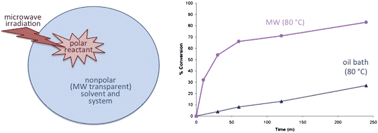
Microwave-actuated organic reactions are defined herein as chemical reaction systems for which microwave irradiation provides a clear benefit over conventional heating to the same temperature. This study is focused on a rationally designed, microwave-actuated reaction (thermal Friedel–Crafts benzylation), in which a microwave-absorbing ionic solute reacts in a non-polar and largely microwave-transparent solvent. Steady-state microwave irradiation (ssMWi) induces observed levels of reactivity from the solute that cannot be duplicated by conventional heating of the homogeneous solution to similar temperatures. This observation is qualitatively consistent with the Arrhenius [k = Ae(−Ea/RT)] relationship between rate and molecular collisions (k ∝ A at constant T). A new paradigm for designing microwave-actuated organic reactions for microwave-assisted organic synthesis emerges from this study.
Fetching data from CrossRef. This may take some time to load.