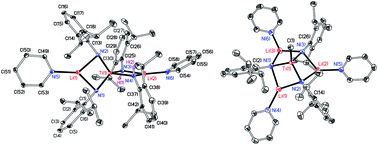
We report a combined experimental and computational study of the first bis(imido) and tris(imido) complexes of a group 4 metal. Reaction of [Ti(NAr)(NHAr)2(py)2] (1, Ar = 2,6-C6H3iPr2) with 3 equivs. of MeLi gave the lithium-stabilised tris(imide) [TiMe(NAr)3{Li(py)}3] (2). Reaction of 1 with 2 equivs. of MeLi in the presence of ArNH2 gave the corresponding bis(imide) [Ti(NAr)2(NHAr)2{Li(py)}2] (3). All three compounds 1, 2 and 3 have substantial Ti–Nimide multiple bond character. Orbital and Mayer bond order analysis show that the formal bond orders are best viewed as ca. 3, 2.5 and 2, respectively, with a further attenuating effect on the multiple bonding by the [Li(py)]+ ion coordination. Compounds 2 and 3 are the first examples of any group 4 metal simultaneously containing two or three multiply-bonded ligands.
You have access to this article
 Please wait while we load your content...
Something went wrong. Try again?
Please wait while we load your content...
Something went wrong. Try again?


 PLATFORM UPDATE: