This website uses cookies to give you the best user experience. If you continue
without changing your settings we'll assume you are happy to receive all RSC cookies.
You can change your cookie settings by navigating to our Privacy and Cookies page and following the instructions. These instructions
are also obtainable from the privacy link at the bottom of any RSC page.
Université de Nice–Sophia Antipolis, Equipe Chimie Organique aux Interfaces, Parc Valrose, France
E-mail: Frederic.GUITTARD@unice.fr
; Fax: (+33)492076156
; Tel: (+33)492076159
b
European Commission, Joint Research Centre, Institute for Health and Consumer Protection, TP203, Via Fermi, Italy
E-mail: Francois.ROSSI@jrc.ec.europa.eu
; Fax: (+39)0332785787
; Tel: (+39)0332785443
RSC Adv., 2012,2, 1033-1039
DOI:
10.1039/C1RA00392E
Received
30 Jun 2011,
Accepted
07 Oct 2011
First published online
30 Nov 2011
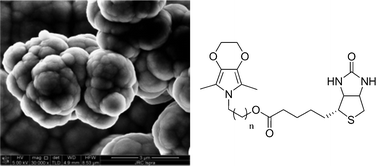
The immobilization of biotin on transducer surfaces is a very important step for the fabrication of biosensors for many applications (immunoassay, DNA-hybridization assays, targeted imaging). Biotinylated polypyrroles have been studied and tested but gave rise to problems of polymerization and stability due to the intrinsic properties of pyrrole. As an alternative, biotinylated pyrroles were often used in a copolymerization with pyrrole or with an amphiphilic pyrrole derivative in a copolymerization to reduce the problems due to the pyrrole substitution. To find a new strategy, this paper presents the homopolymerization, instead of the use of a copolymerization, by replacing pyrrole by 3,4-ethylenedioxypyrrole bearing biotinylated substituent. We report the synthesis, characterization and electrochemical properties of two biotinylated 3,4-ethylenedioxypyrroles differing by the length of the alkyl spacer (ethyl or dodecyl) as well as the characterization of the corresponding polymer films. We successfully show, by cyclic voltammetry, that these monomers polymerize perfectly and give relatively stable polymer films. The increase of the alkyl spacer improves the polymerization and increases the polymer stability. For the first time, we also studied the surface morphology of an electrodeposited biotinylated polymer. The electrodeposition of these biotinylated derivatives gave rise to the ability to modulate the surface microstructuration, which consists of microspheres or cauliflower-like microstructures according to the length of the alkyl spacer.
Fetching data from CrossRef. This may take some time to load.