This website uses cookies to give you the best user experience. If you continue
without changing your settings we'll assume you are happy to receive all RSC cookies.
You can change your cookie settings by navigating to our Privacy and Cookies page and following the instructions. These instructions
are also obtainable from the privacy link at the bottom of any RSC page.
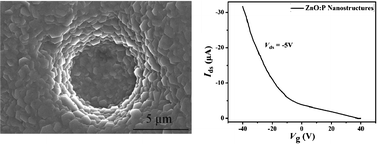
Well-arranged/self-assembled ZnO platelets with durable and reproducible p-type conductivity were synthesized using PCl5 as a dopant source via a simple low cost aqueous based chemical approach. Scanning electron microscopy and selected area diffraction pattern reveal pristine and doped ZnO nanostructures which are single-crystalline and grown predominantly along the [0002] direction. Split UV emission peaks in the photoluminescence spectra are located at 3.324 and 3.2714 eV, which could be attributed to acceptor bound exciton and free electrons to the acceptor emission, respectively. The relative intensity of defect-related broad-band emission (with respect to UV emission) ranging from 480–750 nm is enhanced significantly (ID/IUV = 1–0.056) in doped nanostructures, rendering the creation of defects. A systematic evaluation of room temperature ferromagnetism is found in pristine and doped ZnO nanostructures. p-type Doping is confirmed by photoluminescence spectra and the I–V characteristic of phosphorus doped ZnO nanoplatelets.
Fetching data from CrossRef. This may take some time to load.