


 SCHEDULED MAINTENANCE

Catalytic activity of halohydrin dehalogenases towards spiroepoxides†
Abstract
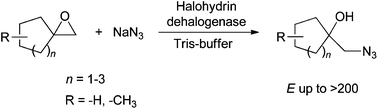
A novel activity of halohydrin dehalogenases towards spiroepoxides has been found. The enzyme from Arthrobacter sp. (HheA) catalysed highly regioselective azidolysis of spiroepoxides containing 5, 6 and 7-membered cycloalkane rings, while the enzyme from Agrobacterium radiobacter (HheC), besides high regioselectivity, also displayed moderate to high enantioselectivity (E up to >200) that can be applied for the kinetic resolution of chiral spiroepoxides. The orientations of spiroepoxides in the active site of halohydrin dehalogenases were studied by quantum-chemical calculations and docking simulations. Analyses of the complexes obtained revealed the origins of diastereoselectivity and enantioselectivity of the investigated biotransformations.
 Please wait while we load your content...


