


 SCHEDULED MAINTENANCE


Strategies for the enantioselective synthesis of spirooxindoles
Abstract
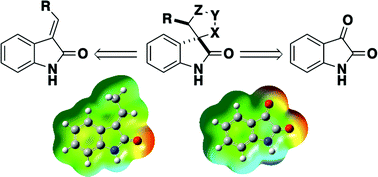
Oxindoles and spirooxindoles are important synthetic targets that are often considered to be prevalidated with respect to their biological activity and applications for pharmaceutical lead discovery. This review features efficient strategies for the enantioselective synthesis of spirocyclic oxindoles, focusing on reports in 2010 and 2011. Although enantioselective synthesis remains an ongoing challenge, exciting recent advances in this area feature spirooxindoles with greater complexity, up to eight stereogenic centers, more practical synthetic methods, and new catalytic activation strategies. Developments in catalyst systems and reaction conditions have shown that many reactions can be optimized to control selectivity and provide access to isomeric products, which are important for biological testing. This review is organized based on two primary disconnection strategies, and then further subdivided into the type and ring size of the spirocycle that is generated. Strategies are also compared for the synthesis of non-spirocyclic 3,3′-disubstituted oxindoles.
 Please wait while we load your content...


