


 SCHEDULED MAINTENANCE

Chemical and semisynthesis of posttranslationally modified proteins
Abstract
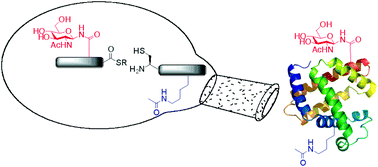
Posttranslational modifications of proteins play crucial roles in health and disease by affecting numerous aspects of protein structure, function, stability and sub cellular localization. Yet understanding the effects of these modifications on several of these processes at the molecular level has been hindered by the lack of homogeneously modified proteins obtained via traditional biochemical and molecular biology approaches. Moreover, the preparation of such bioconjugates at a workable level is highly demanding. Recent advances in protein chemistry applying chemical and semisynthetic approaches are becoming increasingly beneficial to overcome these challenges. These methods allow site-specific modifications of a desired protein and afford the product in large quantities for biochemical and structural analyses. In this review, we survey these efforts and their importance in dissecting the role of several posttranslational modifications in various proteins. Several examples are presented where glycosylated, phosphorylated, ubiquitinated, lipidated, acetylated and methylated proteins were prepared.
- This article is part of the themed collection: Organic & Biomolecular Chemistry 10th Anniversary
 Please wait while we load your content...


