This website uses cookies to give you the best user experience. If you continue
without changing your settings we'll assume you are happy to receive all RSC cookies.
You can change your cookie settings by navigating to our Privacy and Cookies page and following the instructions. These instructions
are also obtainable from the privacy link at the bottom of any RSC page.
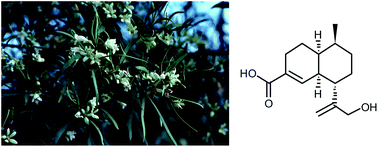
The plant-derived natural product 14-hydroxy-6,12-muuroloadien-15-oic acid (1) was identified as a unique scaffold that could be chemically elaborated to generate novel lead- or drug-like screening libraries. Prior to synthesis a virtual library was generated and prioritised based on drug-like physicochemical parameters such as log P, log D5.5, hydrogen bond donors/acceptors, and molecular weight. The natural product scaffold (1) was isolated from the endemic Australian plant Eremophila mitchellii and then utilised in the parallel solution-phase generation of two series of analogues. The first library consisted of six semi-synthetic amide derivatives, whilst the second contained six carbamate analogues. These libraries have been evaluated for antimalarial activity using a chloroquine-sensitive Plasmodium falciparum line (3D7) and several compounds displayed low to moderate activity with IC50 values ranging from 14 to 33 μM.
Fetching data from CrossRef. This may take some time to load.
Organic & Biomolecular Chemistry
- Information Point