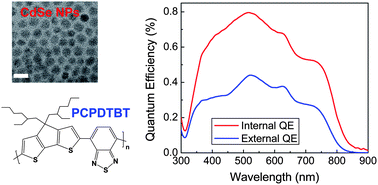
Hybrid organic–inorganic solar cells, as an alternative to all-organic solar cells, have received significant attention for their potential advantages in combining the solution-processability and versatility of organic materials with high charge mobility and environmental stability of inorganic semiconductors. Here we report efficient and air-stable hybrid organic–inorganic solar cells with broad spectral sensitivity based on a low-gap polymer poly[2,6-(4,4-bis-(2-ethylhexyl)-4H-cyclopenta[2,1-b;3,4-b′]-dithiophene)-alt-4,7-(2,1,3-benzothiadiazole)] (PCPDTBT) and spherical CdSe nanoparticles. The solvents used for depositing the hybrid PCPDTBT:CdSe active layer were shown to strongly influence the film morphology, and subsequently the photovoltaic performance of the resulted solar cells. Appropriate post-deposition annealing of the hybrid film was also shown to improve the solar cell efficiency. The inclusion of a thin ZnO nanoparticle layer between the active layer and the metal cathode leads to a significant increase in device efficiency especially at long wavelengths, due to a combination of optical and electronic effects including more optimal light absorption in the active layer and elimination of unwanted hole leakage into the cathode. Overall, maximum power conversion efficiencies up to 3.7 ± 0.2% and spectral sensitivity extending above 800 nm were achieved in such PCPDTBT:CdSe nanosphere hybrid solar cells. Furthermore, the devices with a ZnO nanoparticle layer retained ∼70% of the original efficiency after storage under ambient laboratory conditions for over 60 days without any encapsulation.
You have access to this article
 Please wait while we load your content...
Something went wrong. Try again?
Please wait while we load your content...
Something went wrong. Try again?


 SCHEDULED MAINTENANCE


