


 SCHEDULED MAINTENANCE


Methane storage in molecular nanostructures
Abstract
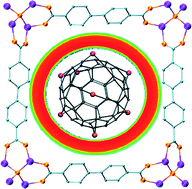
We survey various molecular structures which have been proposed as possible nanocontainers for methane storage. These are molecular structures that have been investigated through either experiments, molecular dynamics simulations or mathematical modelling. Computational simulation and mathematical modelling play an important role in predicting and verifying experimental outcomes, but both have their limitations. Even though recent advances have greatly improved computations, due to the large number of atoms and force field calculations involved, computational simulations can still be time consuming as compared to an instantaneous mathematical modelling approach. On the other hand, underlying an ideal mathematical model, there are many assumptions and approximations, but such modelling often reveals the key physical parameters and optimal configurations. Here, we review methane
 Please wait while we load your content...


