


Cellular transport and homeostasis of essential and nonessential metals
Abstract
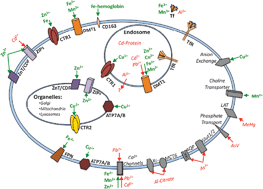
Metals can have a number of detrimental or beneficial effects in the cell, but first they must get in. Organisms have evolved transport mechanisms to get metals that are required, or essential into the cell. Nonessential metals often enter the cell through use of the machinery provided for essential metals. Much work has been done to advance our understanding of how these metals are transported across plasma and organelle membranes. This review provides an overview of essential and nonessential metal transport and homeostatic processes.
- This article is part of the themed collection: Metals and Genetics
 Please wait while we load your content...