This website uses cookies to give you the best user experience. If you continue
without changing your settings we'll assume you are happy to receive all RSC cookies.
You can change your cookie settings by navigating to our Privacy and Cookies page and following the instructions. These instructions
are also obtainable from the privacy link at the bottom of any RSC page.
Chemical Engineering and Process Development Division, CSIR-National Chemical Laboratory, Dr. Homi Bhabha Road, Pune, India
E-mail: cj.gadgil@ncl.res.in
; Fax: +91-20-25902612
; Tel: +91-20-25902163
b
CSIR-Institute of Genomics and Integrative Biology, Mall Road, Delhi, India
E-mail: skb@igib.res.in
Mol. BioSyst., 2012,8, 2145-2152
DOI:
10.1039/C2MB25046B
Received
10 Feb 2012,
Accepted
24 Apr 2012
First published online
26 Apr 2012
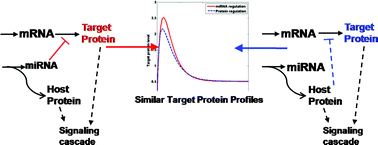
The importance of microRNA (miRNA) in modulating gene expression at the post-transcriptional level is well known. Such regulation has been shown to influence the dynamics of several regulatory networks including the cell cycle. In this study we incorporated regulatory effects of intronic miRNA into an existing mathematical model of the cell cycle through the use of an existing ‘proxy’ protein – the host protein. It was observed that the incorporation of intronic miRNA mediated regulation improved the performance of the model resulting in a closer match to experimental results. To test the universality of this approach we compared the effects of intronic miRNA mediated regulation and host protein mediated regulation. Further, we compared miRNA mediated and protein mediated positive and negative feedback regulations of the target protein. We found that the target protein profiles were predominantly similar. These observations show the applicability of our method for incorporating intronic miRNA mediated dynamic effects in models for regulation of gene expression.
Fetching data from CrossRef. This may take some time to load.