This website uses cookies to give you the best user experience. If you continue
without changing your settings we'll assume you are happy to receive all RSC cookies.
You can change your cookie settings by navigating to our Privacy and Cookies page and following the instructions. These instructions
are also obtainable from the privacy link at the bottom of any RSC page.
Technical University of Denmark, Department of Micro- and Nanotechnology, Kgs. Lyngby, Denmark
E-mail: joerg.kutter@nanotech.dtu.dk
; Tel: +45 4525 6312
Lab Chip, 2012,12, 4651-4656
DOI:
10.1039/C2LC40543A
Received
10 May 2012,
Accepted
20 Jun 2012
First published online
21 Jun 2012
Conventional methods of environmental analysis can be significantly improved by the development of portable microscale technologies for direct in-field sensing at remote locations. This report demonstrates the vast potential of gold nanoparticle-based microfluidic sensors for the rapid, in-field, detection of two important classes of environmental contaminants – heavy metals and pesticides. Using gold nanoparticle-based microfluidic sensors linked to a simple digital camera as the detector, detection limits as low as 0.6 μg L−1 and 16 μg L−1 could be obtained for the heavy metal mercury and the dithiocarbamate pesticide ziram, respectively. These results demonstrate that the attractive optical properties of gold nanoparticle probes combine synergistically with the inherent qualities of microfluidic platforms to offer simple, portable and sensitive sensors for environmental contaminants.
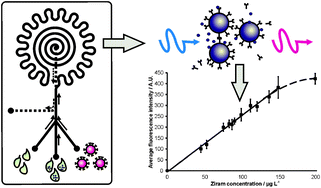
Conventional methods of environmental analysis can be significantly improved by the development of portable microscale technologies for direct in-field sensing at remote locations. This report demonstrates the vast potential of gold nanoparticle-based microfluidic sensors for the rapid, in-field, detection of two important classes of environmental contaminants - heavy metals and pesticides. Using gold nanoparticle-based microfluidic sensors linked to a simple digital camera as the detector, detection limits as low as 0.6 µg L–1 and 16 µg L–1 could be obtained for the heavy metal mercury and the dithiocarbamate pesticide ziram, respectively. These results demonstrate that the attractive optical properties of gold nanoparticle probes combine synergistically with the inherent qualities of microfluidic platforms to offer simple, portable and sensitive sensors for environmental contaminants.
Fetching data from CrossRef. This may take some time to load.