


Abstract
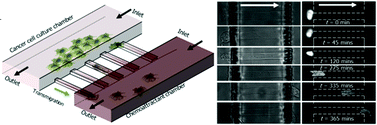
Metastasis is the main cause of cancer mortality. During this process, cancer cells dislodge from a primary tumor, enter the circulation and form secondary tumors in distal organs. It is poorly understood how these cells manage to cross the tight syncytium of endothelial cells that lines the capillaries. Such capillary transmigration would require a drastic change in cell shape. We have therefore developed a microfluidic platform to study the transmigration of cancer cells. The device consists of an array of microchannels mimicking the confined spaces encountered. A thin glass coverslip bottom allows high resolution imaging of cell dynamics. We show that nuclear deformation is a critical and rate-limiting step for transmigration of highly metastatic human breast cancer cells. Transmigration was significantly reduced following the treatment with a
 Please wait while we load your content...


