This website uses cookies to give you the best user experience. If you continue
without changing your settings we'll assume you are happy to receive all RSC cookies.
You can change your cookie settings by navigating to our Privacy and Cookies page and following the instructions. These instructions
are also obtainable from the privacy link at the bottom of any RSC page.
Nanoscale Science and Engineering Center, Department of Food Science and Technology, University of Georgia, Athens, USA
E-mail: jingchen@uga.edu and huang@uga.edu
b
Nanoscale Science and Engineering Center, Department of Biological and Agricultural Engineering, University of Georgia, Athens, USA
E-mail: jabell@uga.edu
c
Nanoscale Science and Engineering Center, Department of Physics and Astronomy, University of Georgia, Athens, USA
E-mail: zhaoy@physast.uga.edu
; Fax: (706)542-2492
; Tel: 1-(706)5427792
Lab Chip, 2012,12, 3096-3102
DOI:
10.1039/C2LC40221A
Received
29 Feb 2012,
Accepted
23 Apr 2012
First published online
24 Apr 2012
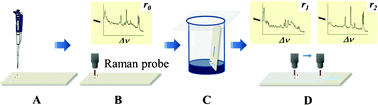
We demonstrate that silver nanorod (AgNR) array substrates can be used for on-chip separation and detection of chemical mixtures by combining ultra-thin layer chromatography (UTLC) and surface enhanced Raman spectroscopy (SERS). The UTLC-SERS plate consists of an AgNR array fabricated by oblique angle deposition. The capability of the AgNR substrates to separate the different compounds in a mixture was explored using a mixture of four dyes and a mixture of melamine and Rhodamine 6G at varied concentrations with different mobile phase solvents. After UTLC separation, spatially-resolved SERS spectra were collected along the mobile phase development direction and the intensities of specific SERS peaks from each component were used to generate chromatograms. The AgNR substrates demonstrate the potential for separating the test dyes with plate heights as low as 9.6 μm. The limits of detection are between 10−5–10−6 M. Furthermore, we show that the coupling of UTLC with SERS improves the SERS detection specificity, as small amounts of target analytes can be separated from the interfering background components.
We demonstrate that silver nanorod (AgNR) array substrates can be used for on-chip separation and detection of chemical mixtures by combining ultra-thin layer chromatography (UTLC) and surface enhanced Raman spectroscopy (SERS). The UTLC-SERS plate consists of an AgNR array fabricated by oblique angle deposition. The capability of the AgNR substrates to separate the different compounds in a mixture was explored using a mixture of four dyes and a mixture of melamine and Rhodamine 6G at varied concentrations with different mobile phase solvents. After UTLC separation, spatially-resolved SERS spectra were collected along the mobile phase development direction and the intensities of specific SERS peaks from each component were used to generate chromatograms. The AgNR substrates demonstrate the potential for separating the test dyes with plate heights as low as 9.6 µm. The limits of detection are between 10–5-10–6 M. Furthermore, we show that the coupling of UTLC with SERS improves the SERS detection specificity, as small amounts of target analytes can be separated from the interfering background components.
Fetching data from CrossRef. This may take some time to load.