This website uses cookies to give you the best user experience. If you continue
without changing your settings we'll assume you are happy to receive all RSC cookies.
You can change your cookie settings by navigating to our Privacy and Cookies page and following the instructions. These instructions
are also obtainable from the privacy link at the bottom of any RSC page.
Department of Micro- and Nanotechnology, Technical University of Denmark (DTU), Building 345 East, DK-2800 Kgs. Lyngby, Denmark
E-mail: klmo@nanotech.dtu.dk
; Fax: +45 45887762
; Tel: +45 45256304
Lab Chip, 2012,12, 1951-1958
DOI:
10.1039/C2LC40102A
Received
27 Jan 2012,
Accepted
26 Mar 2012
First published online
30 Mar 2012
The objective of this article is to provide an overview and critical evaluation of the use of carbon nanotubes and related carbon-based nanomaterials for microchip chromatography. The unique properties of carbon nanotubes, such as a very high surface area and intriguing adsorptive behaviour, have already been demonstrated in more classical formats, for improved separation performance in gas and liquid chromatography, and for unique applications in solid phase extraction. Carbon nanotubes are now also entering the field of microfluidics, where there is a large potential to be able to provide integrated, tailor-made nanotube columns by means of catalytic growth of the nanotubes inside the fluidic channels. An evaluation of the different implementations of carbon nanotubes and related carbon-based nanomaterials for microfluidic chromatography devices is given in terms of separation performance and ease of fabrication.
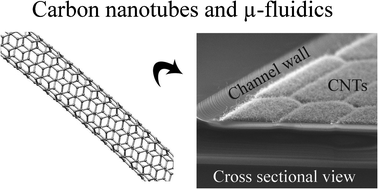
The objective of this article is to provide an overview and critical evaluation of the use of carbon nanotubes and related carbon-based nanomaterials for microchip chromatography. The unique properties of carbon nanotubes, such as a very high surface area and intriguing adsorptive behaviour, have already been demonstrated in more classical formats, for improved separation performance in gas and liquid chromatography, and for unique applications in solid phase extraction. Carbon nanotubes are now also entering the field of microfluidics, where there is a large potential to be able to provide integrated, tailor-made nanotube columns by means of catalytic growth of the nanotubes inside the fluidic channels. An evaluation of the different implementations of carbon nanotubes and related carbon-based nanomaterials for microfluidic chromatography devices is given in terms of separation performance and ease of fabrication (review).
Fetching data from CrossRef. This may take some time to load.