


 SCHEDULED MAINTENANCE


Microengineered physiological biomimicry: Organs-on-Chips†
Abstract
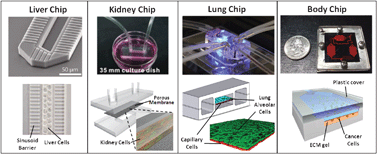
Microscale engineering technologies provide unprecedented opportunities to create cell culture microenvironments that go beyond current three-dimensional in vitro models by recapitulating the critical tissue–tissue interfaces, spatiotemporal chemical gradients, and dynamic mechanical microenvironments of living organs. Here we review recent advances in this field made over the past two years that are focused on the development of ‘Organs-on-Chips’ in which living cells are cultured within microfluidic devices that have been microengineered to reconstitute tissue arrangements observed in living organs in order to study physiology in an organ-specific context and to develop specialized in vitro disease models. We discuss the potential of organs-on-chips as alternatives to conventional cell culture models and animal testing for
- This article is part of the themed collection: Focus on USA
 Please wait while we load your content...


