This website uses cookies to give you the best user experience. If you continue
without changing your settings we'll assume you are happy to receive all RSC cookies.
You can change your cookie settings by navigating to our Privacy and Cookies page and following the instructions. These instructions
are also obtainable from the privacy link at the bottom of any RSC page.
School of Engineering, University of British Columbia, 3333 University Way Kelowna, BC, Canada
E-mail: h.najjaran@ubc.ca
; Fax: +1 250 807 8713
; Tel: +1 250 807 8713
Lab Chip, 2012,12, 2053-2059
DOI:
10.1039/C2LC21241B
Received
13 Dec 2011,
Accepted
07 Mar 2012
First published online
15 Mar 2012
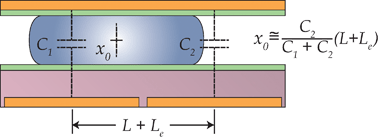
Digital microfluidic (DMF) devices manipulate minuscule droplets through basic fluidic operations including droplet transport, mixing and splitting commonly known as the building blocks for complete laboratory analyses on a single device. A DMF device can house various chemical species and confine chemical reactions within the volume of a droplet much like a micro-reactor. The automation of fluidic protocols requires a feedback controller whose sensor is capable of locating droplets independent of liquid composition (or previous knowledge of liquid composition). In this research, we present an estimator that tracks the continuous displacement of a droplet between electrodes of a DMF device. The estimator uses a dimensionless ratio of two electrode capacitances to approximate the position of a droplet, even, in the domain between two adjacent electrodes. This droplet position estimator significantly enhances the control precision of liquid handling in DMF devices compared to that of the techniques reported in the literature. It captures the continuous displacement of a droplet; valuable information for a feedback controller to execute intricate fluidic protocols including droplet positioning between electrodes, droplet velocity and acceleration control. We propose a state estimator for tracking the continuous droplet displacement between two adjacent electrodes. The dimensionless nature of this estimator means that any droplet composition can be sensed. Thus, no calibration for each chemical species within a single DMF device is required. We present theoretical and experimental results that demonstrate the efficacy of the position estimator in approximating the position of the droplet in the interval between two electrodes.
Fetching data from CrossRef. This may take some time to load.