


 SCHEDULED MAINTENANCE

A ternary model for double-emulsion formation in a capillary microfluidic device†
Abstract
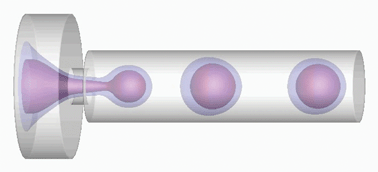
To predict double-emulsion formation in a capillary microfluidic device, a ternary diffuse-interface model is presented. The formation of double emulsions involves complex interfacial phenomena of a three-phase fluid system, where each component can have different physical properties. We use the Navier–Stokes/Cahn–Hilliard model for a general ternary system, where the hydrodynamics is coupled with the thermodynamics of the phase field variables. Our model predicts important features of the double-emulsion formation which was observed experimentally by Utada et al. [Utada et al., Science, 2005, 308, 537]. In particular, our model predicts both the dripping and jetting regimes as well as the transition between those two regimes by changing the flow rate conditions. We also demonstrate that a double emulsion having multiple inner drops can be formed when the outer interface is more stable than the inner interface.
 Please wait while we load your content...


