


 SCHEDULED MAINTENANCE


Microfluidic synthesis of advanced microparticles for encapsulation and controlled release†
Abstract
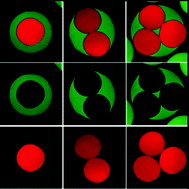
We describe droplet microfluidic strategies used to fabricate advanced microparticles that are useful structures for the encapsulation and release of actives; these strategies can be further developed to produce microparticles for advanced drug delivery applications. Microfluidics enables exquisite control in the fabrication of polymer vesicles and thermosensitive microgels from single and higher-order multiple emulsion templates. The strategies used to create the diversity of microparticle structures described in this review, coupled with the scalability of microfluidics, will enable fabrication of large quantities of novel microparticle structures that have potential uses in controlled drug release applications.
- This article is part of the themed collection: Focus on USA
 Please wait while we load your content...


