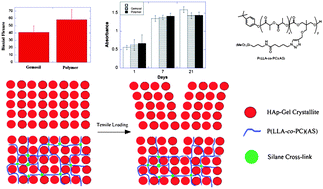
Causes of bone deficiency are numerous, but biomimetic alloplastic grafts provide an alternative to repair tissue naturally. Previously, a hydroxyapatite–gelatin modified siloxane (HAp–Gemosil) composite was prepared by cross-linking N,N′-bis[(3-trimethoxysilyl)propyl]ethylene diamine (enTMOS) around the HAp–gel nanocomposite particles, to mimic the natural composition and properties of bone. However, the tensile strength remained too low for many orthopedic applications. It was hypothesized that incorporating a polymer chain into the composite could help improve long range interaction. Furthermore, designing this polymer to interact with the enTMOS siloxane cross-linked matrix would provide improved adhesion between the polymer and the ceramic composite, and improve mechanical properties. To this end, copolymers of L-lactide (LLA), and a novel alkyne derivatized trimethylene carbonate, propargyl carbonate (PC), were synthesized. Incorporation of PC during copolymerization affects properties of copolymers such as molecular weight, Tg, and %PC incorporation. More importantly, PC monomers bear a synthetic handle, allowing copolymers to undergo post-polymerization functionalization with graft monomers to specifically tailor the properties of the final composite. For our investigation, P(LLA-co-PC) copolymers were functionalized by an azido-silane (AS) via copper catalyzed azide–alkyne cycloaddition (CuAAC) through terminal alkyne on PC monomers. The new functionalized polymer, P(LLA-co-PC)(AS) was blended with HAp–Gemosil, with the azido-silane linking the copolymer to the silsesquioxane matrix within the final composite. These HAp–Gemosil–P(LLA-co-PC)(AS) composites were subjected to mechanical and biological testing, and the results were compared with those from the HAp–Gemosil composites. This study revealed that incorporating a cross-linkable polymer served to increase the flexural strength of the composite by 50%, while maintaining the biocompatibility of HAp–Gemosil ceramics.


 SCHEDULED MAINTENANCE

 Please wait while we load your content...
