This website uses cookies to give you the best user experience. If you continue
without changing your settings we'll assume you are happy to receive all RSC cookies.
You can change your cookie settings by navigating to our Privacy and Cookies page and following the instructions. These instructions
are also obtainable from the privacy link at the bottom of any RSC page.
Journal of Materials Chemistry was published between 1991 and 2012. From issue 1, 2013, it was replaced by three new journals: Journal of Materials Chemistry A, B and C
School of Polymers and High Performance Materials, Shelby F. Thames Polymer Science Research Center, The University of Southern Mississippi, Hattiesburg, USA
E-mail: marek.urban@usm.edu
J. Mater. Chem., 2012,22, 16104-16113
DOI:
10.1039/C2JM31126G
Received
22 Feb 2012,
Accepted
22 May 2012
First published online
09 Jul 2012
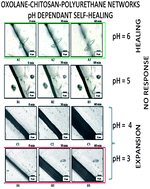
These studies show that oxolane–chitosan–polyurethane (OXO–CHI–PUR) networks exhibit self-repairing behavior upon exposure to UV light. Spectroscopic analysis revealed that molecular level processes responsible for the self-repairing mechanism of OXO–CHI–PUR networks are driven by free radical catalyzed polyurea-to-polyurethane conversion, formation of linear –C–O–C– segments via ring opening of OXO rings, as well as chair-to-boat conformational changes of glycosine units of the CHI backbone macromonomer. Incorporation of the OXO five-member ring instead of OXE (four-member) into polyurethane networks facilitates slower but equally effective self-healing characteristics. The role of protic conditions inside the scratch showed that highly acidic environments favor scratch expansions instead of self-healing. Similar to self-healing of OXE–CHI–PUR networks, as a result of mechanical damage, glass transition temperature (Tg) is lowered within the damaged area, resulting in the formation of smaller macromolecular oligomeric entities with enhanced mobility. The repair mechanisms measured by the thermo-mechanical response inside and outside the scratch showed that upon UV light exposure the damaged area is repaired by the frontal growth reactions from the bottom of the scratch to the top, and the mass flow is facilitated by the lower glass transition temperature (Tg) inside the scratch. These studies also show that the presence of hindered amine light stabilizers (HALSs) retards self-healing, which can be compensated by elevated levels of the OXO component in OXO–CHI–PUR networks.
Fetching data from CrossRef. This may take some time to load.
Journal of Materials Chemistry
- Information Point
This text is added as a work around for heading error in Accessibility testing