This website uses cookies to give you the best user experience. If you continue
without changing your settings we'll assume you are happy to receive all RSC cookies.
You can change your cookie settings by navigating to our Privacy and Cookies page and following the instructions. These instructions
are also obtainable from the privacy link at the bottom of any RSC page.
Journal of Materials Chemistry was published between 1991 and 2012. From issue 1, 2013, it was replaced by three new journals: Journal of Materials Chemistry A, B and C
Department of Materials Science and Milano-Bicocca Solar Energy Research Center – MIB-Solar, University of Milano-Bicocca, Via Cozzi 53, Milano, Italy
E-mail: alessandro.abbotto@unimib.it
; Fax: +39 02 64485400
; Tel: +39 02 64485227
J. Mater. Chem., 2012,22, 11364-11369
DOI:
10.1039/C2JM30481C
Received
25 Jan 2012,
Accepted
29 Mar 2012
First published online
03 Apr 2012
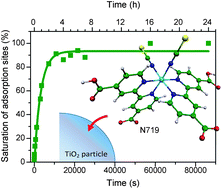
A new spectroscopic tool for the quantitative evaluation of dye-sensitizer uptake into TiO2 semiconductor films for application in DSCs is presented, here applied to N719 dye and TiO2-dye dipping times spanning from a few seconds up to 24 h. By the integration of the whole absorption spectrum in the Vis range or of the most significant low-energy peak, a conversion table could be built to be used as a reliable tool for evaluating the amount of adsorbed dye from the spectral response of the dye-coated films, independently of any spectral modification of the response with dipping time (indeed observed). In particular for N719 under the investigated conditions, we have demonstrated that the first hour is strategic for an effective uptake of the dye by the TiO2 nanoparticles, with a saturation level reached within the first 5 h, suggesting that commonly used longer dipping times, typically 16–24 h, are useless or even undesirable when making DSC devices. In addition, we have found that the whole adsorption process, from few seconds up to 24 h dipping time, is very nicely described by a simple pseudo-first order kinetic model, in contrast with previous findings, with an observed rate constant of 3.1 × 10⁻⁴ s−1.
Fetching data from CrossRef. This may take some time to load.
Journal of Materials Chemistry
- Information Point
This text is added as a work around for heading error in Accessibility testing