This website uses cookies to give you the best user experience. If you continue
without changing your settings we'll assume you are happy to receive all RSC cookies.
You can change your cookie settings by navigating to our Privacy and Cookies page and following the instructions. These instructions
are also obtainable from the privacy link at the bottom of any RSC page.
Journal of Materials Chemistry was published between 1991 and 2012. From issue 1, 2013, it was replaced by three new journals: Journal of Materials Chemistry A, B and C
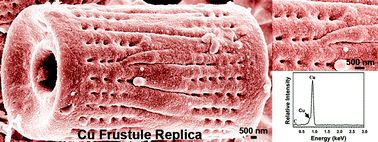
A combined layer-by-layer (LbL) surface amine amplification and electroless deposition process has been developed to convert biologically replicable three-dimensional (3-D) nanostructured micro-assemblies (such as siliceous diatom frustules) into freestanding Cu-bearing or Ni-bearing structures that retain the starting biogenic microscale 3-D shapes and nanoscale patterns. After reacting the hydroxyl-bearing surfaces of these biotemplates with an aminosilane, a LbL polyacrylate/polyamine deposition process was used to dendritically amplify the surface amine concentration. Subsequent binding of metal chloridecatalysts to these amine-enriched surfaces enabled the rapid electroless deposition of thin, conformal, continuous, and nanocrystalline or amorphous metallic coatings on the 3-D biotemplates. Selective removal of the underlying templates then yielded freestanding Cu-bearing or Ni-bearing structures. The conformality and continuity of the thin coatings, and the fidelity with which the biogenic shape and fine features were preserved in the freestanding structures, were significantly enhanced by the amplification of surface amines (and the associated enrichment of catalytic sites) resulting from the LbL polyacrylate/polyamine treatment. Monolithic and multicomponent structures (e.g., Cu, multilayer Au/Cu, CuO, and Ni–P alloy) with bio-derived morphologies have been synthesized utilizing this approach. This readily-scalable process may be used to convert self-assembled rigid templates (of biological or synthetic origin) into nanostructured transition metal-based micro-assemblies with a wide variety of selectable 3-D hierarchical morphologies for use in numerous functional and structural applications.
Fetching data from CrossRef. This may take some time to load.
This may take some time to load.
Journal of Materials Chemistry
- Information Point
This text is added as a work around for heading error in Accessibility testing