


Evaluation of colloidal silicagels for lead isotopic measurements using thermal ionisation mass spectrometry†
Abstract
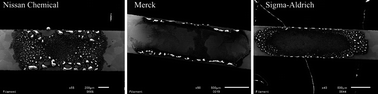
In this study we have investigated the suitability of silicagels from four companies (Merck, Sigma-Aldrich, Nissan Chemical and Alfa Aesar) as emission activators for ionisation of lead in thermal ionisation mass spectrometry (TIMS). We have tested U and Pb blank levels, ionisation efficiency, signal stability, degree of fractionation, and reproducibility and accuracy of the Pb isotopic ratios measured with these emitters. Further tests were undertaken to evaluate the dependency of ionisation efficiency on the particle size and concentration of silicagels and the mixing ratio of silicagel and phosphoric acid. Mass fractionation, reproducibility and stability of the ion beam were monitored using 300 pg of the lead isotopic standard SRM-981. The Merck and Sigma-Aldrich silicagels have the best performance as Pb ion emitters. They yielded accurate Pb isotopic ratios with precisions of ∼0.05% (2SD) for 207Pb/206Pb. We find that the ionisation efficiency does not depend on the particle size, but on silicagel concentration and proportion of silicagel to phosphoric acid. The highest ionisation efficiency (9.2 ± 2.2%, 2SE) was obtained using 0.004 ml of a silicagel from Sigma-Aldrich at a concentration of 0.4 wt% of SiO2 loaded with 0.05 ml of 0.02 N phosphoric acid. These results clearly indicate that the Sigma-Aldrich emitter is an excellent alternative for Pb isotopic measurements to the widely used, but no longer produced Merck silicagel. The silicagels from Alfa Aesar and Nissan Chemical have a high U background concentration compared to the Merck and Sigma-Aldrich gels, and produce less accurate Pb isotopic ratios.
 Please wait while we load your content...


