This website uses cookies to give you the best user experience. If you continue
without changing your settings we'll assume you are happy to receive all RSC cookies.
You can change your cookie settings by navigating to our Privacy and Cookies page and following the instructions. These instructions
are also obtainable from the privacy link at the bottom of any RSC page.
Single particle inductively coupled plasma mass spectrometry: evaluation of three different pneumatic and piezo-based sample introduction systems for the characterization of silver nanoparticles
Institute of Inorganic and Analytical Chemistry, University of Münster, Corrensstr. 30, D-48149 Münster, Germany
E-mail: carsten.engelhard@uni-muenster.de
J. Anal. At. Spectrom., 2012,27, 1074-1083
DOI:
10.1039/C2JA00003B
Received
03 Jan 2012,
Accepted
21 Feb 2012
First published online
22 Feb 2012
This article is part of themed collection:
Nanoanalysis
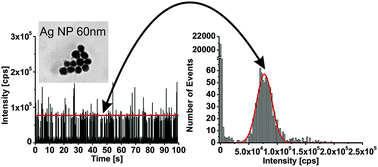
Engineered nanomaterials are used increasingly around the world. In recent years, environmental concerns have being raised that call for risk assessment, toxicity studies, and nanosafety policies. It is therefore important to provide analytical tools that are able to characterize various types of nanomaterials in a sensitive and fast fashion. In this study, the analytical performance of three sample introduction systems, a PFA micronebulizer with a Peltier-cooled cyclonic spray chamber (PC3), a PFA micronebulizer with a heated cyclonic spray chamber and three-stage Peltier-cooled desolvation system (APEX Q), and a monodisperse droplet generator (Microdrop) with an in-house built spray chamber, was compared for the characterization of silver nanoparticles (Ag NP) with different sizes (20–100 nm) using single particle inductively coupled plasma mass spectrometry (SP-ICP-MS). With continuous polydisperse and pulsed monodisperse droplet sample introduction, single 30 nm NP (PC3) and 20 nm NP (APEX Q, Microdrop), respectively, were successfully detected. Detection efficiencies (20–100 nm Ag NP) were in the range of 5.8 × 10⁻⁵ to 8.2 × 10⁻⁵ counts per atom, cpa (PC3), 7 × 10⁻⁵ to 9.5 × 10⁻⁵ cpa (APEX Q), and 8.1 × 10⁻⁵ to 1.2 × 10⁻⁴ cpa (Microdrop). For a given nanoparticle sample, the variation of the relative standard deviation (RSD) of the size distribution width among the three systems was found to be 1–4% (e.g. 1.3% for 100 nm Ag NP with RSDs of 16.3%, 16.8%, and 17.6% for Microdrop, APEX Q, and PC3, respectively). Size measurements performed by SP-ICP-MS were validated by transmission electron microscopy measurements. Because silver toxicity depends on the silver species in the sample, simultaneous detection of Ag NP and free Ag(I) ions was studied with droplet sample introduction.
Fetching data from CrossRef. This may take some time to load.
Journal of Analytical Atomic Spectrometry
- Information Point