This website uses cookies to give you the best user experience. If you continue
without changing your settings we'll assume you are happy to receive all RSC cookies.
You can change your cookie settings by navigating to our Privacy and Cookies page and following the instructions. These instructions
are also obtainable from the privacy link at the bottom of any RSC page.
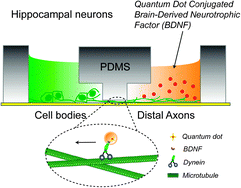
Brain derived neurotrophic factor (BDNF) plays a key role in the growth, development and maintenance of the central and peripheral nervous systems. Exogenous BDNF activates its membrane receptors at the axon terminal, and subsequently sends regulation signals to the cell body. To understand how a BDNF signal propagates in neurons, it is important to follow the trafficking of BDNF after it is internalized at the axon terminal. Here we labeled BDNF with bright, photostable quantum dots (QD-BDNF) and followed the axonal transport of QD-BDNF in real time in hippocampal neurons. We showed that QD-BDNF was able to bind BDNF receptors and activate downstream signaling pathways. When QD-BDNF was applied to the distal axons of hippocampal neurons, it was observed to be actively transported toward the cell body at an average speed of 1.11 ± 0.05 μm s−1. A closer examination revealed that QD-BDNF was transported by both discrete endosomes and multivesicular body-like structures. Our results showed that QD-BDNF could be used to track the movement of exogenous BDNF in neurons over long distances and to study the signaling organelles that contain BDNF.
Fetching data from CrossRef. This may take some time to load.