This website uses cookies to give you the best user experience. If you continue
without changing your settings we'll assume you are happy to receive all RSC cookies.
You can change your cookie settings by navigating to our Privacy and Cookies page and following the instructions. These instructions
are also obtainable from the privacy link at the bottom of any RSC page.
Department of Chemistry and Biochemistry, University of South Carolina, 631 Sumter Street, Columbia, USA
E-mail: wang@mail.chem.sc.edu
; Fax: +1 803 777 9521
; Tel: +1 803 777 8436
b
State Key Laboratory of Polymer Physics and Chemistry, Changchun Institute of Applied Chemistry, Chinese Academy of Sciences, Changchun 130022, PR China
E-mail: linyuan@ciac.jl.cn
Integr. Biol., 2012,4, 651-660
DOI:
10.1039/C2IB20041D
Received
24 Feb 2012,
Accepted
21 Mar 2012
First published online
27 Mar 2012
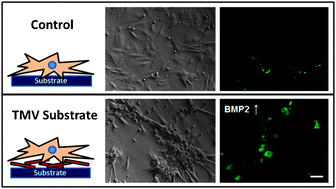
Many nanoscale materials have been developed to investigate the effects on stem cell differentiations via topographical and chemical cues for applications in tissue engineering and regenerative medicine. The use of plant viruses as cell supporting substrates has been of particular interest due to the rapid induction of bone marrow derived mesenchymal stem cells (BMSCs) towards osteogenic cells. In this study, the role of Tobacco mosaic virus (TMV) and its early effects on osteoinduction with particular emphasis on the regulation of bone morphogenetic protein-2 (BMP2) was examined. We observed that the cells on the virus substrate immediately aggregated and formed bone-like nodules within 24 hours. An immediate increase in BMP2 gene and protein expression for cells on the TMV substrate was observed within 8 hours of osteoinduction. Moreover, BMP2 expression was highly localized to cells within the cell aggregates. This enhanced differentiation only occurred when TMV was coated on a solid support but not upon adding the virus to the media solution. Taken together, the results from this study highlight the potential of virus-based nanomaterials to promote endogenous BMP2 production which may prove to be a unique approach to studying the regulatory mechanisms involved in early osteoblastic differentiation.
Fetching data from CrossRef. This may take some time to load.