This website uses cookies to give you the best user experience. If you continue
without changing your settings we'll assume you are happy to receive all RSC cookies.
You can change your cookie settings by navigating to our Privacy and Cookies page and following the instructions. These instructions
are also obtainable from the privacy link at the bottom of any RSC page.
Centre for the Theory and Application of Catalysis, School of Chemistry and Chemical Engineering, Queen’s University Belfast, David Keir Building, Stranmillis Road, Belfast, UK
Green Chem., 2012,14, 1643-1648
DOI:
10.1039/C2GC35147A
Received
31 Jan 2012,
Accepted
02 Apr 2012
First published online
30 Apr 2012
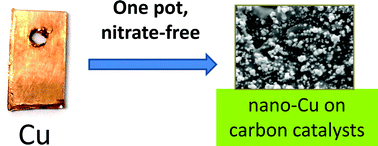
Electrodeposition of metals onto conductive supports such as graphite potentially provides a lower-waste method to form heterogeneous catalysts than the standard methods such as wet impregnation. Copper electrodeposition onto pressed graphite disc electrodes was investigated from aqueous CuSO4–ethylenediamine solutions by chronoamperometry with scanning electron microscopy used to ascertain the particle sizes obtained by this method. The particle size was studied as a function of pH, CuSO4–ethylenediamine concentration, and electrodeposition time. It was observed that decreasing the pH, copper–ethylenediamine concentration and time each decreased the size of the copper particles observed, with the smallest obtained being around 5–20 nm. Furthermore, electroless aerobic oxidation of copper metal in the presence of ethylenediamine was successfully coupled with the electrodeposition in the same vessel. In this way, deposition was achieved sequentially on up to twenty different graphite discs using the same ethylenediamine solution, demonstrating the recyclability of the ligand. The materials thus prepared were shown to be catalytically active for the mineralisation of phenol by hydrogen peroxide. Overall, the results provide a proof-of-principle that by making use of aerobic oxidation coupled with electrochemical deposition, elemental base metals can be used directly as starting materials to form heterogeneous catalysts without the need to use metal salts as catalyst precursors.
Fetching data from CrossRef. This may take some time to load.